LEGO Serious Play: A Method for Thinking Together About Complexity
LEGO® Serious Play® (LSP) is a facilitated methodology designed to help individuals and teams think more clearly about complex topics. It is used in strategy, leadership alignment, organizational change, innovation, and culture work, particularly when conversations feel stuck, abstract, or dominated by a few voices.
Although LEGO bricks are central to the process, LEGO Serious Play is not about play in the casual sense. It is a structured method grounded in facilitation discipline, reflection, and shared meaning-making.
What LEGO Serious Play Is
LEGO Serious Play is a methodology originally developed by LEGO to support business and organizational development. It is based on the idea that people think more deeply and communicate more effectively when they build representations of their thinking.
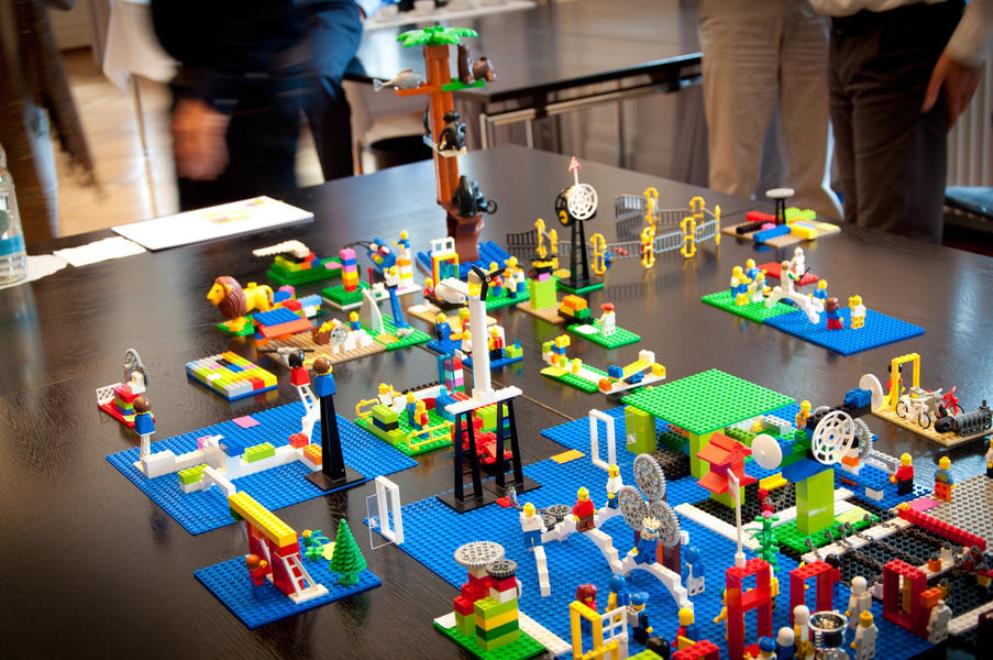
In an LSP workshop, participants build three-dimensional models using LEGO bricks in response to carefully designed questions. These models represent ideas, assumptions, experiences, relationships, or systems. Each participant then explains the meaning of their model, using it as a metaphor for their thinking.
The meaning does not come from the bricks themselves. It comes from the story the builder attaches to the model.
Why Building Changes the Conversation
Most group conversations rely almost entirely on verbal reasoning. This tends to privilege speed, confidence, hierarchy, and familiarity with abstract language. LEGO Serious Play deliberately changes this dynamic.
By building first and speaking second, participants are given time to reflect. Thinking becomes externalized and visible. Instead of debating opinions, the group explores models and the meaning behind them.
This shift has several important effects. Everyone participates. Tacit knowledge surfaces naturally. Difficult topics can be addressed with less defensiveness. Patterns and tensions become visible without needing to be argued into existence.
In short, the method slows the conversation down in order to make it deeper.
The Role of Metaphor
The Structure of the Method
LEGO Serious Play is not improvised. It follows a clear structure that builds understanding step by step.
Participants typically begin with short exercises to learn how to express meaning through building. From there, they move to individual models in response to strategic or reflective questions. These individual perspectives are then combined into shared models, and later into system models that explore relationships, dependencies, risks, and opportunities.
The process concludes with reflection and synthesis, translating insights from the models into actions, priorities, or decisions.
The structure is essential. When it is respected, the method creates clarity. When it is diluted, it loses much of its power.
The Role of the Facilitator
The facilitator is central to the success of a LEGO Serious Play workshop.
Their role is not to interpret models or provide answers. Instead, they design precise questions, hold the structure of the process, and create psychological safety so that every participant can contribute fully.
Good facilitation ensures that hierarchy is minimized, participation is equal, and meaning stays with the builder of each model. This discipline is what allows honest conversations to emerge without turning into debate or persuasion.
When LEGO Serious Play Is Most Effective
LEGO Serious Play is particularly useful when teams are dealing with complexity, ambiguity, or change. It works well for leadership teams, founders, cross-functional groups, and organizations navigating growth or transformation.
It is especially valuable when conversations feel repetitive, when alignment is assumed but unclear, or when important issues remain unspoken.
LEGO Serious Play is not a shortcut, and it is not entertainment. It requires focus, openness, and skilled facilitation. When those conditions are present, it enables conversations that are difficult to achieve through traditional workshops.
What LEGO Serious Play Is Not
LEGO Serious Play is not gamification. It is not an icebreaker. It is not about creativity for its own sake, and it is not about building the “best” model.
It does not replace analysis, expertise, or decision-making. Instead, it supports them by helping teams understand what is really happening before moving forward.